
HVAC Missed Call Cost: Calculate Your Revenue Leak Now
Picture this: you're knee-deep in a crawlspace, flashlight in one hand, wrench in the other, sweat stinging your eyes. Your phone buzzes on the truck dash—another emergency call from a frantic homeowner with a busted AC on a 95-degree day. But you're elbow-deep in ducts, can't wipe your hands clean fast enough, and by the time you scramble out, it's gone to voicemail. Or worse, straight to silence. That unanswered ring? It's not just noise. It's HVAC missed call cost bleeding your revenue dry, one ring at a time.
For owner-operators like you—running 2-15 tech teams, still strapping on tools yourself, chasing inbound phones and emergency bookings—this is daily reality. Every missed call is a potential job vanishing into the ether, handed to the competitor who picks up on ring two. Titan Revenue Growth Systems gets it: you're building an owner-led company, not chasing ghosts. But those ghosts add up. In this Titan Insights deep dive, we'll uncover your missed calls HVAC revenue loss, arm you with the exact formula to calculate it, and show how to plug the leaks—starting with our free Revenue Leak Audit.
Where Your Revenue Leaks: The 7 Silent Killers of HVAC Bookings
Revenue doesn't evaporate in big bursts for small HVAC and plumbing outfits. It drips away through tiny cracks—moments when a call slips through because life on the job site is unforgiving. Techs in active jobs, owners grabbing lunch, drive time between stops, after-hours emergencies when everyone's clocked out. Add website forms that languish, spam filters gobbling leads, and zero follow-up on voicemails. These aren't excuses; they're math problems.
Here's the checklist of the seven biggest leak points. Tick them off against your operation:
- Active jobs: Tech buried in a furnace install, phone muted or buried in a toolbox.
- Lunch and breaks: The one hour a day when everyone's off-grid, but emergencies don't clock out.
- Drive time: Stuck in traffic, Bluetooth glitches, or hands-free distractions.
- After-hours: Nights and weekends when 40% of service calls hit—check out our upcoming guide on after-hours emergency call handling.
- Website form delay: Leads submit online, but no one's watching the inbox.
- Spam filtering: Voicemails or texts routed to junk by aggressive carriers.
- No follow-up: Calls ring out, no text-back—miss the missed-call text-back workflow post for fixes.
Sound familiar? These aren't rare glitches. They're baked into owner-led companies juggling field work and phones. The good news: you can quantify the damage right now.
Calculate Your HVAC Missed Call Cost: The Formula That Exposes Hidden Losses
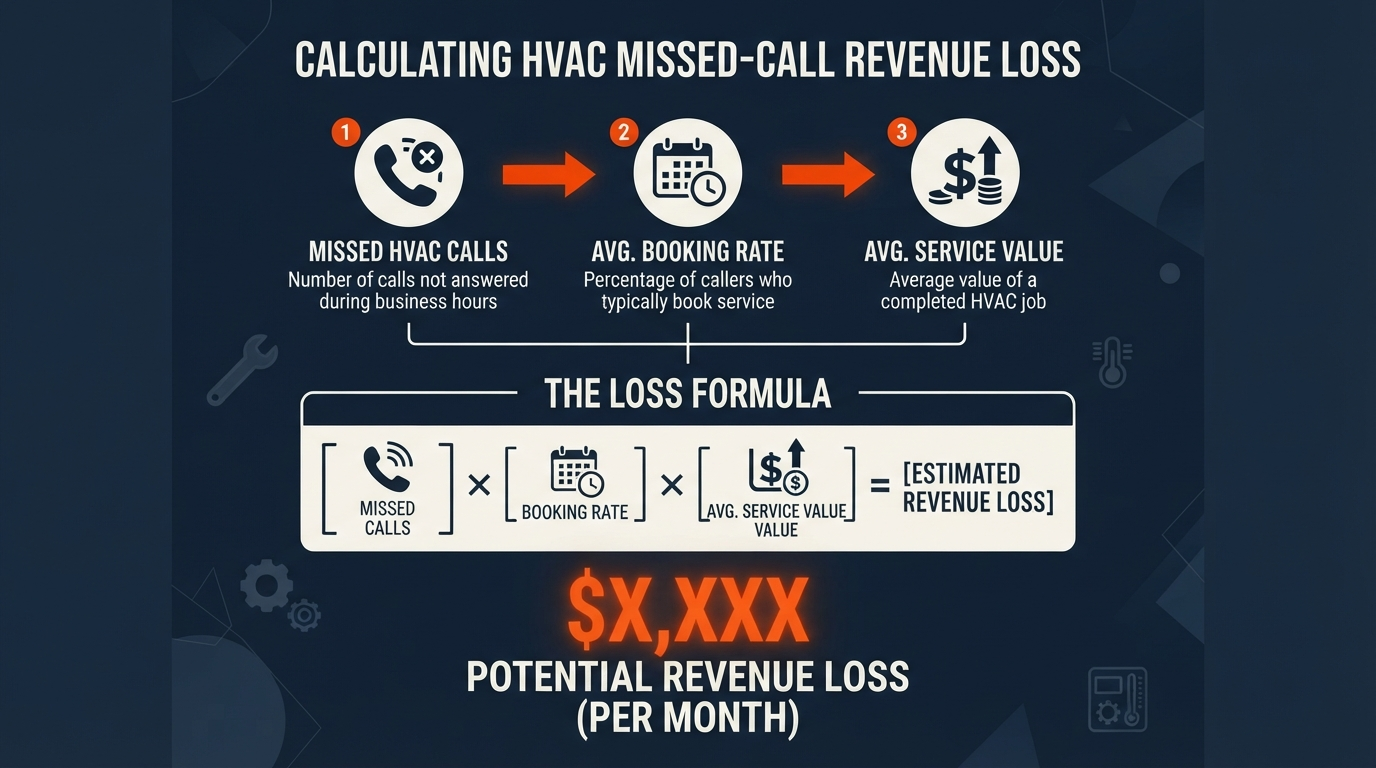
No fluff, no guesswork. Here's the straightforward formula to nail your HVAC lead loss calculation:
Monthly Inbound Calls × Estimated Missed % × Booking Rate × Average Booked Job Value = Potential Revenue Exposure
ILLUSTRATIVE EXAMPLE ONLY—use your own numbers for accuracy. Say your HVAC company logs 500 inbound calls monthly. You estimate 20% missed (conservative; many hit 30-40%). Booking rate? 60% on answered calls. Average ticket? $1,200.
Crunch it: 500 × 0.20 × 0.60 × $1,200 = $72,000 in potential exposure per month. That's $864,000 yearly—enough to hire two techs, upgrade trucks, or finally take that vacation. Plumbing missed call revenue follows the same math; swap in your drain-clearing averages.
Your 5-Step Revenue Leak Worksheet
Pull your data in under 15 minutes. No fancy software needed—just your call logs and booking software.
- Count monthly inbound calls: Check Google Voice, RingCentral, or carrier logs for total rings (answered + missed + voicemail).
- Estimate missed %: Divide unanswered/voicemail by total. Start with 20-30% if unsure—audit a week's calls for precision.
- Calculate booking rate: Answered calls that turn into jobs ÷ Total answered calls. Aim for 50-70%; low? Train dispatch.
- Average booked job value: Total revenue ÷ Jobs completed. Include service, repairs, installs—your true ticket average.
- Plug into formula: Multiply it out. Double-check seasonality (more on that in FAQ).
Pro tip: Track how many calls HVAC companies miss weekly to spot patterns—like spikes during peak service season.
Track Missed Calls Without Hiring Full-Time Staff
You don't need a dispatcher eating payroll. Forward calls to a shared line app (like Smith.ai or your carrier's multi-ring). Set alerts for misses. Text-back every unanswered ring within 5 minutes—boosts HVAC booking rate by recapturing 40% of leads. Integrate with Google Business Profile for form leads. Log everything in a free Google Sheet: date, time, outcome. Review weekly over coffee. Boom—tracking on autopilot, owner-led style.
Titan's 24/7 Booking Recovery for HVAC & Plumbing takes it further: turn missed calls into booked jobs without you lifting a finger from the roof.
FAQ: Answering Your Top Questions on Missed Calls and Revenue
How Do I Know My True Miss Rate?
Dive into call logs for a 7-day sample. (Answered + Voicemail + No Answer) ÷ Answered = Total Inbounds. Missed = (Voicemail + No Answer) ÷ Total. Cross-check with CRM for ghosted leads.
What's Average Job Value vs. Average Ticket?
Job value is revenue per booked call (e.g., $1,200 including upsells). Ticket is per invoice. Use job value for HVAC missed call cost—it captures full opportunity.
How Does Seasonality Affect This?
Summer AC surges mean more calls, higher misses if understaffed. Run monthly calcs; scale formula by seasonal inbound spikes (e.g., ×1.5 in July).
What's the Difference Between Lost Calls and Lost Revenue?
Lost calls are rings that don't connect. Lost revenue factors booking rate and ticket value. A missed call isn't always a zero— but ignoring it guarantees one.
Seal the Leaks: Start with Titan's Free Revenue Leak Audit
You've got the math. Now act. Titan Revenue Growth Systems offers straightforward pricing and an installation fee that pays for itself fast. Claim your free Revenue Leak Audit at titanrevenuesystems.com/#audit. We'll pinpoint where calls drop and hand you the fixes—no sales pitch, just results.
Don't let another ring fade unanswered. Calculate your leak, plug it, and watch booked jobs stack up. Your revenue's waiting.